Lifecycle and Responsibility
Telemetry crosses two lines on its way from a source system to a destination. It enters DataStream when a device collects it, and it leaves when a destination acknowledges receipt. Between those two points every stage runs inside your own environment under DataStream control. Outside them, what a source emits and how a destination retains, indexes, and serves the data are properties of those systems. This page states where each line falls.
Provider → Device → Preprocessing → Pipeline → Postprocessing → Target → Consumer
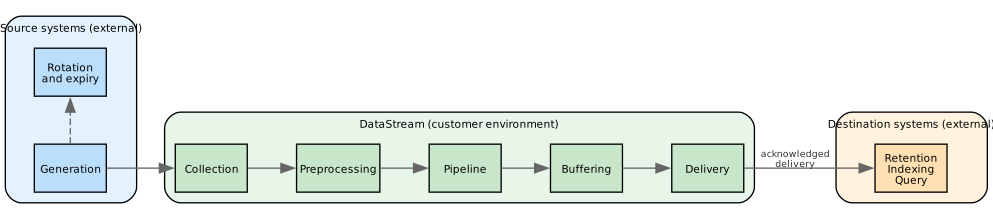
Stage Ownership
| Stage | What happens | Controlled by | Notes |
|---|---|---|---|
| Generation | Source systems emit logs, metrics, traces, and events | Source system | DataStream does not control what a source emits, or when |
| Collection | Push-type devices listen for incoming data and pull-type devices poll the source, across protocols, cloud platforms, message queues, databases, and agents; OTLP carries logs, metrics, and traces | DataStream | Runs in your infrastructure. Agents run the same pipeline engine as the Director, so filtering and masking can happen at the point of collection |
| Preprocessing | Parsing, normalization to a canonical schema, schema validation, and per-source drift detection | DataStream | Drift findings are written to the record and can be routed to notification processors |
| Pipeline processing | Transformation, enrichment, redaction and masking against curated rulesets, and volume reduction through deduplication, suppression, sampling, aggregation, and cardinality limits | DataStream | All processing is local to your environment |
| Buffering | Per-target worker pools, retries with exponential backoff, and persistent or crash-resistant storage | DataStream | The disk queue and the durable streams each hold 48 hours by default; both are configurable |
| Delivery | Criteria-based routing, per-destination transformation, fan-out, and staged rollout through a pipeline's staging version | DataStream, to acknowledged delivery | Responsibility ends here: a record is DataStream's until the destination acknowledges it |
| Retention, indexing, and query | Storage duration, index strategy, and search at the SIEM, data lake, or object store | Destination system | DataStream chooses the destination by routing policy but manages nothing after delivery |
| Rotation and expiry at source | Log rotation and retention on the originating system | Source system | Runs in parallel with the chain rather than after it |
Where Control Begins and Ends
Control begins at collection. A device running on your infrastructure is the first component DataStream owns; everything before it belongs to the source system.
Control ends at acknowledged delivery. Until a destination confirms receipt, the record is DataStream's responsibility; from that point, retention, indexing, and search belong to the destination. Between the two lines — parsing, normalization, enrichment, redaction, reduction, buffering, routing — every stage runs inside your own environment. The deployment and network model this rests on is described in Architecture.
When a destination does not acknowledge, the record stays in the durable queue and is redelivered to the same destination until it succeeds or its retention window expires.
Observing the Boundary
A responsibility boundary is only useful if you can see where a record stands relative to it. Three surfaces show that:
- Delivery counters per destination, reported alongside the volume each pipeline takes in and sends out, on the Stats Overview page.
- Queue depth, backpressure, and consumer lag, available as alert rules that raise an alert when a destination stops keeping up.
- The durable backlog itself, which holds 48 hours by default.
queue.limitgoverns the on-disk queue andpersistent_storage.max_agethe durable streams; both are documented in the service configuration reference.
The Control Plane and Log Content
The control plane carries configuration, fleet state, and telemetry counters. It performs no data processing, and in normal operation it does not receive log content: the Director holds a single outbound connection to it, and nothing connects inward.
One path is an exception, and it is operator-initiated. Live Data captures real records at a chosen processing stage so they can be read in the web interface; Console Logs does the same for the Director's internal debug messages. Only the first carries log content. Both are bounded sessions rather than continuous tails: a capture runs for at most 60 seconds, collects at most 5,000 events, and stops on its own when either limit is reached. Nothing is captured unless an operator starts one.
On that path the content is encrypted from where it enters the platform to the browser that asked for it. The platform reads a record as it arrives and encrypts its message and raw original there, for the one browser that started the capture. From that point on the content is ciphertext everywhere: in the capture stream, between platform instances, on the browser's connection, and to anything that terminates TLS in front of the console, such as a load balancer or an inspection proxy. The browser makes a fresh key pair for each capture; its private half cannot be read out, is never stored, and is discarded when the page closes. The suite is ECDH on P-521, HKDF with SHA3-512, and AES-256-GCM, the primitives NCS-1:2020 lists at its ADVANCED level. What stays readable is what the platform needs to route and label a record: its time, the components it came from, its source address, its entry type and its sizes. A record the platform cannot encrypt is dropped rather than sent unencrypted.
Captures are not kept. The platform holds a capture's records in memory only, for at most ten minutes, and removes them sooner once the capture is released. The content can also be masked where it enters the platform, before it is encrypted. A masked capture's original sensitive values never leave the platform: only the masked content reaches the browser.
Outside the Boundary
Two parts of the lifecycle sit outside the pipeline by design.
Before collection, the source system decides what to emit, at what verbosity, and how long to keep its own copy. DataStream can filter and reduce what it has collected, but it cannot make a source emit a field the source never wrote.
After delivery, the destination decides storage duration, index strategy, and query behavior. DataStream influences this at one remove: routing policy chooses which destination a record reaches, so compliance data can be directed to long-term object storage while operational data goes to the SIEM. That is a choice of destination, not management of the data once it arrives.